A Lakewood car accident gives you the right to pursue compensation from the at-fault driver, and what you do in the first weeks often decides how much you recover. How you handle insurance contact, medical treatment, and legal deadlines shapes the claim before it is ever filed.
I represent injured drivers and passengers in Lakewood and throughout Pierce County. This page explains how car accident claims work in Washington, what causes most serious crashes in this area, and what the legal process looks like from the first call to final resolution.
Call (253) 946-0577 or contact us online for a free consultation with personal injury attorney Chong Hae Ye.
Table of contents
- Key Takeaways About Lakewood Car Accident Cases:
- What Causes Most Car Accidents in Lakewood?
- What Is the Legal Process After a Lakewood Car Accident?
- Associations
- What Can You Recover After a Lakewood Car Accident?
- Past Case Results
- Ask The Ye Law Firm Injury Lawyers: Lakewood Car Accident Questions
- What to Expect When You Work With The Ye Law Firm Injury Lawyers
- Learn More About Your Possible Legal Case
Key Takeaways About Lakewood Car Accident Cases:
- Washington is a fault state, meaning the driver who caused the crash is financially responsible for the resulting damages through their liability insurance.
- Pierce County's road network, including South Tacoma Way, SR-512, and roads adjacent to Joint Base Lewis-McChord, produces recurring collision patterns at predictable locations.
- Washington's pure comparative fault rule under RCW 4.22.005 allows recovery even when the injured person shares partial responsibility for the crash.
- Most car accident injury claims in Washington must be filed within three years of the crash date under RCW 4.16.080, with shorter deadlines when government vehicles or road defects are involved.
- The legal process in a car accident case moves through distinct phases, each with its own strategic considerations and decision points.
What Causes Most Car Accidents in Lakewood?
Most serious Lakewood crashes come down to driver error, distraction, impairment, speeding, and failure to yield, concentrated on a handful of high-conflict corridors. South Tacoma Way alone packs vehicle conflict points across its entire length.
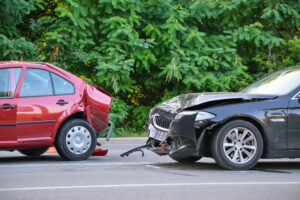
Left-turn movements across oncoming traffic and commercial access points generate angle and rear-end collisions throughout the day. SR-512 carries freeway-speed traffic between Pierce and Thurston counties, and its interchange with I-5 produces merge conflicts that cause high-severity crashes.
The roads surrounding Joint Base Lewis-McChord, including Bridgeport Way SW and Gravelly Lake Drive SW, see volume spikes during shift changes that create predictable congestion-related collision patterns.
Beyond road design, most serious crashes in the Lakewood area share common human causes.
Distracted and Inattentive Driving
Distracted driving is among the most common causes of serious car accidents across Washington, according to state traffic safety data from the Washington Traffic Safety Commission. Smartphones, in-vehicle technology, and commercial corridor driving create conditions where a momentary lapse produces serious consequences.
Distraction is also one of the most contested liability issues in car accident cases. Carriers for at-fault drivers routinely argue that their driver was attentive and that the claimant contributed to the crash.
Obtaining phone records, dashcam footage, and witness statements early is how that argument gets countered with evidence.
Impaired and Fatigued Driving
Lakewood's proximity to JBLM means a portion of serious crashes involve drivers returning from late shifts or affected by substances. Washington law imposes strict liability standards for impaired driving, and a DUI citation against the at-fault driver strengthens a civil claim significantly.
Fatigue operates similarly to impairment in terms of reaction time and judgment. It can be established through witness accounts, time-of-day crash data, and the at-fault driver's prior schedule.
Speeding and Aggressive Driving
SR-512 and the I-5 corridor through Lakewood see consistent speeding violations, particularly during off-peak hours when enforcement is lighter. Aggressive lane changes and tailgating on surface streets like South Tacoma Way and Steilacoom Boulevard SW produce crashes that might have been avoided at posted speeds.
Speed affects both liability and damages. Higher-speed crashes produce more severe injuries, which means higher medical costs, longer recovery timelines, and larger non-economic losses.
Failure to Yield and Intersection Negligence
Intersection crashes account for a significant share of serious collisions in Lakewood. The commercial density along South Tacoma Way and the volume of left-turn movements at unsignalized intersections create ongoing conflict between through traffic and turning vehicles.
Washington law places the duty to yield on specific drivers in specific situations. Establishing that the at-fault driver violated that duty, and that the violation caused the crash, is the core of most intersection liability arguments.
When my car got rear-ended a year ago on my way to work, it was the worst time of my life and experience. It was the first car accident I experienced since 30 years of driving. I got so stressed out and didn't know what to do. I immediately contacted The Ye Law Firm for help. I received not only great service, but Mr. Ye and his team were professional and responsive. I felt the care as well as empathy from my first consultation to the resolution of my case. Ever since my great experience with them I have been referring multiple friends, family and college,,,, if they need any legal assistance. I would highly recommend their services to any potential clients.Thank you The Ye Law Firm.
Google Review
What Is the Legal Process After a Lakewood Car Accident?
Most people who contact me after a crash have never been through a personal injury claim before. Understanding what the process looks like from the first call through final resolution helps clients make informed decisions at each stage.
Step 1: Medical Treatment and Documentation
The legal process begins before any attorney is involved. How medical treatment is handled in the days and weeks after a car crash shapes what is provable later.
Prompt treatment, consistent follow-through, and detailed provider notes create the documented record a claim depends on. A gap in treatment, even one driven by cost or scheduling difficulty, gives insurers a basis to argue that injuries resolved or were unrelated to the crash.
I work with clients to understand the connection between their treatment decisions and their legal position throughout the recovery period.
Step 2: Investigation and Evidence Preservation
Once I take a case, the first priority is evidence. Police reports, witness statements, traffic camera footage, and physical evidence from the crash scene require active collection and preservation.
In crashes involving commercial vehicles, data from onboard systems may be available and requires a legal hold to prevent deletion. Reconstruction experts are engaged when liability is disputed or when the crash dynamics are complex.
I build the factual foundation of a claim before any contact with the at-fault carrier, not after.
Step 3: Insurance Claim and Negotiation
After your treatment reaches maximum medical improvement, the point where your condition has stabilized and further recovery is not expected, or when future costs can be calculated accurately, I submit a demand package to the at-fault carrier.
That package documents liability, injury causation, economic damages, and non-economic losses in detail. The carrier responds with its own evaluation. Negotiation follows.
Most cases resolve at this stage. Resolution at a number that reflects what the claim is actually worth requires preparation that most unrepresented claimants do not have time to do on their own.
Step 4: Litigation in Pierce County Superior Court
When an insurer refuses to negotiate reasonably, or when liability is genuinely disputed in ways that require judicial resolution, I file suit in Pierce County Superior Court.
Litigation involves formal discovery, including depositions, document requests, and expert disclosure. Most cases that enter litigation settle before trial.
The credible threat of trial is often what produces reasonable offers from carriers who were not willing to negotiate in good faith during the claim phase. I prepare every case for trial from the beginning, because that preparation is what creates leverage in car accident settlement negotiations.
Associations




What Can You Recover After a Lakewood Car Accident?
Washington law does not cap recovery in car accident cases. The full economic and non-economic impact of a crash is compensable, provided the evidence supports it.
Call (253) 946-0577 or reach out online to discuss what your specific situation may support.
Past Case Results
How Much Is Your Lakewood Car Accident Claim Worth?
The value of a claim depends on two categories of damages: economic and non-economic. Both are recoverable under Washington law and both are consistently underrepresented in early settlement offers.

The responsible driver has a legal obligation to pay you for both past and future damages. The challenge comes in knowing how much you are eligible for, especially because it is difficult to predict the future. That is where I come into the picture.
I review the documentation from your case to help you understand what your car accident claim may be worth, and I work with qualified professionals when needed to quantify the full scope of your damages. That picture matters before you approach the insurance company, not after.
If the insurer will not offer a fair number, I am prepared to take the case to court. The goal at every stage is a result that reflects what you actually lost.
Ask The Ye Law Firm Injury Lawyers: Lakewood Car Accident Questions
What should I say to the insurance company after a Lakewood car accident?
Limit contact to basic identifying information and the fact that a crash occurred. Do not give a recorded statement to the at-fault carrier without speaking with an attorney first. Do not admit fault or speculate about injuries. The other party's adjuster is building a file, not helping you resolve your situation fairly.
How does Washington's comparative fault rule affect my claim?
Washington's pure comparative fault system reduces your recovery by your percentage of fault but does not eliminate it. A claimant found 30 percent at fault can still recover 70 percent of their damages. Carriers routinely assign inflated fault percentages. That assignment requires a direct evidentiary response built into the case from the start.
What if the crash involved a government vehicle or a road defect on a public road?
It depends who the government entity is. Claims involving a city, county, or state vehicle, or a road defect on a public road, fall under Washington's tort claims statute, which requires a formal written claim and a 60-day wait before suit. Claims against a federal entity, such as a Joint Base Lewis-McChord vehicle, follow the Federal Tort Claims Act instead. I identify which rules apply early.
What happens if my injuries turn out to be more serious than they first appeared?
This is one of the most important reasons not to accept an early settlement offer. Once a release is signed, the claim is closed regardless of what develops afterward. I advise clients to complete treatment, or reach a clear understanding of future treatment needs, before any settlement is finalized.
How is pain and suffering calculated in a Lakewood car accident case?
Washington does not use a fixed formula for non-economic damages. Pain and suffering, emotional distress, and loss of enjoyment of life are assessed based on the nature and severity of the injury, the duration of recovery, and the long-term impact on daily life. Medical records, provider testimony, and personal accounts all contribute to that calculation.
What if the at-fault driver fled the scene or cannot be identified?
Your own uninsured motorist coverage is typically the primary source of recovery in hit-and-run crashes. Washington law requires insurers to offer that coverage, and you may reject it in writing. I review your full policy and all available coverage sources when the at-fault driver cannot be identified.
What to Expect When You Work With The Ye Law Firm Injury Lawyers
Lakewood and Pierce County clients who contact me get a straightforward answer about their case during the first conversation. I do not take cases I do not believe in, and I do not give inflated assessments to secure a retainer.
For the cases I do take, clients work directly with me at every stage. I handle the insurer communications, review the medical records, manage the evidence gathering, and make litigation decisions in direct conversation with the client.
Pierce County Superior Court is where these cases go when insurers do not negotiate reasonably. I am prepared to take them there when that is what the situation requires.
I serve clients in English, Korean, and Spanish. Lakewood has a large Korean-American community and a growing Spanish-speaking population. I built my practice to serve those communities with the same quality of representation available to anyone else.
Language access is not an accommodation at The Ye Law Firm Injury Lawyers. It is a core part of how I make sure clients understand what is happening in their case and why, at every stage of the process.
Learn More About Your Possible Legal Case

The decisions made in the first days after a Lakewood car accident have consequences that last for the entire life of a claim. What you say, what you sign, and how you handle medical treatment all affect what you can recover later.
If you were injured in a car accident in Lakewood or anywhere in Pierce County, I am available to review what happened and give you an honest assessment of your options before any of those decisions become final.
I serve clients in English, Korean, and Spanish. All cases are handled on a contingency fee basis.
Call (253) 946-0577 or contact The Ye Law Firm Injury Lawyers online to schedule a free consultation with attorney Chong Hae Ye.